Practical information for businesses and organisations who are considering purchasing an AED.
Publications
A guide to AEDs: This guide provides information about AEDs and how they can be deployed in the community to help resuscitate a victim of cardiac arrest.
CPR, AEDs and the law: A guide on the obligations and responsibilities of those who attempt the resuscitation of anyone suffering a suspected sudden cardiac arrest, and to provide guidance for organisations that are contemplating providing life-saving equipment and training for those who might use it.
Cardiovascular Implanted Electronic Devices: Guidance on Cardiovascular Implanted Electronic Devices (CIEDs) in people towards the end of life, during cardiopulmonary resuscitation (CPR) and after death.
Resuscitation to recovery: A National Framework to improve care of people with out-of-hospital cardiac arrest (OHCA) in England
Resources
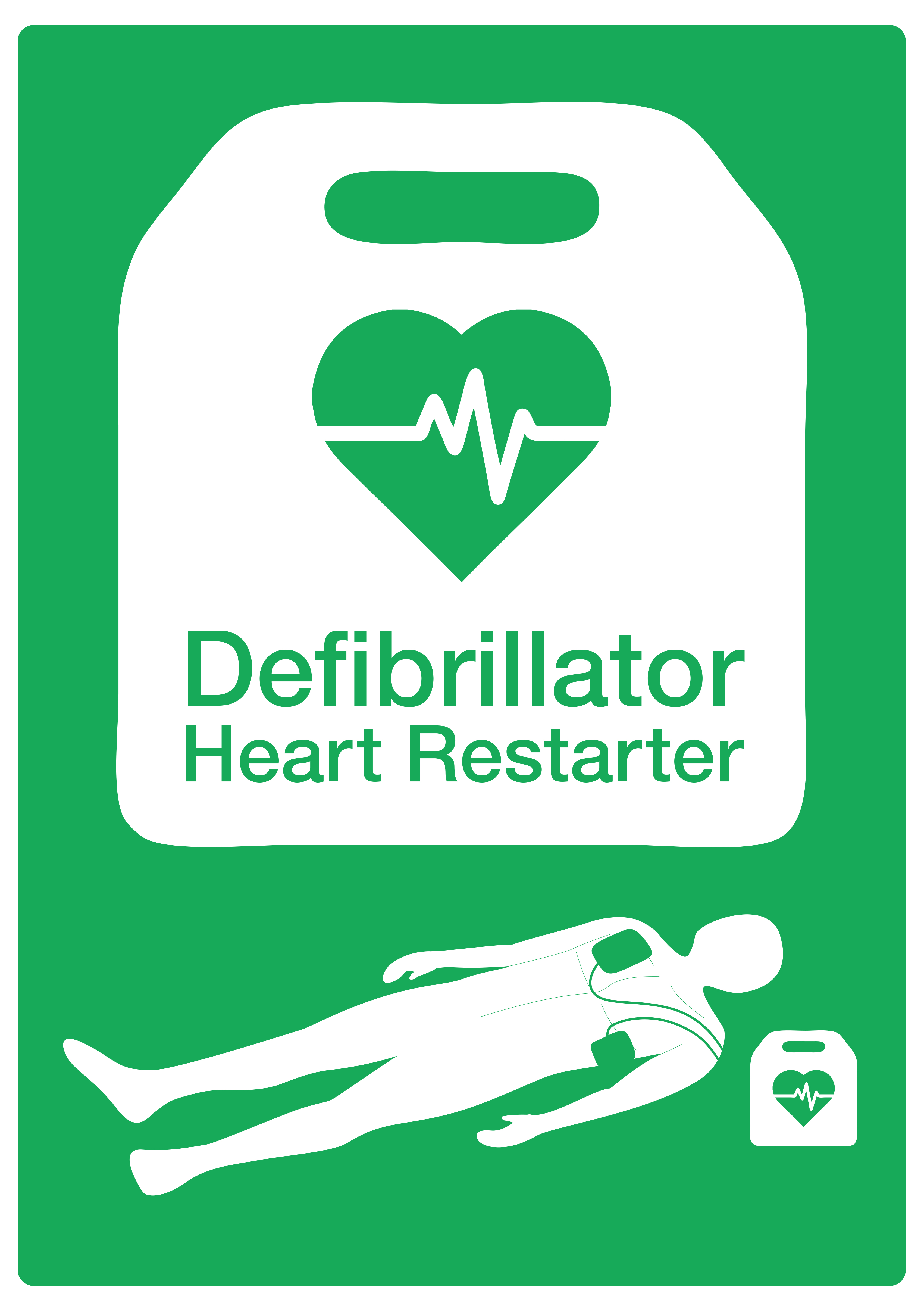
Standard sign for AEDs: Download our AED sign and learn more about how it was created.
The Circuit: Register your defibrillator with The Circuit to ensure ambulance services can locate it during emergencies. Join the national defibrillator network today
FAQs
Resuscitation Council UK and British Heart Foundation have written a Guide to Automated External Defibrillators (AEDs) which gives full information about the use of AEDs in the community. We urge you to read this as it will answer your questions in more detail.
Sudden cardiac arrest (SCA) occurs because the normal electrical rhythm that controls the heart is replaced by a chaotic disorganised electrical rhythm called ventricular fibrillation (VF).
An AED delivers a high energy electric shock to an individual in SCA caused by VF to restore the heart’s normal rhythm. AEDs are compact, portable, easy to use and guide the operator through the process with prompts and commands. The AED analyses precisely the individual's heart rhythm and will only deliver a shock if it is required.
AEDs are very reliable and will not allow a shock to be given unless it is needed. They are extremely unlikely to do any harm to a person who has collapsed in suspected Sudden Cardiac Arrest. They are safe to use and present minimal risk to the rescuer. These features make them suitable for use by members of the public with little or no training).
Public Access Defibrillation describes the use of AEDs by members of the public. AEDs can now be found in many busy public places including airports, mainline railway stations, shopping centres, and gyms. They are meant to be used by members of the public if they witness a cardiac arrest.
Your nearest rescue-ready public access AED can be found on the national defibrillator network, The Circuit.
When calling the emergency services, the call handler will also tell you where the nearest PAD will be.
RCUK has designed a sign that many public spaces equipped with a PAD will display. There are many different signs that mark the location of the AED. When you call the ambulance service you will be directed to the nearest registered device. Staff working at the location should also know the location of an AED nearby.
Your nearest rescue ready public access AED can be found on the national defibrillator network, The Circuit.
When calling the emergency services, the call handler will also tell you where the nearest PAD will be.
AEDs have been used by untrained people to save lives. Clear, spoken instructions and visual illustrations guide users through the process. Lack of training should not be a barrier to someone using one. If a person is in cardiac arrest, do not be afraid to use an AED.
Yes, it is usually safe to use an AED on an individual who is lying on a metallic, wet or other conductive surface. If the self-adhesive pads are applied correctly, and provided there's no direct contact between the user and the individual when the shock is delivered, there is no direct pathway that electricity can take that would cause the user to experience a shock. If the individual is wet, their chest should be dried so that the self-adhesive AED pads will stick properly.
Yes. The incidence of shockable rhythms requiring defibrillation in children is very low but can occur. The priority must always be for high-quality CPR and getting expert help. However, the AED can be used across all age groups if this is the only available machine.
The paediatric advanced life support Guidelines state that if using an AED on a child of less than eight years, a paediatric attenuated shock energy should be used if possible.
Experience with the use of AEDs (preferably with dose attenuator) in children younger than one year is limited. The use of an AED is acceptable if no other option is available as, on balance, it is probably better to give a 50 J shock than nothing at all. The upper safe limit for dosage in this group is unknown.
Yes. Fortunately cardiac arrest is rare in people who are pregnant, but if it were to occur it is quite appropriate to use an AED. The procedure is the same as in the non-pregnant but it is important to place the pads clear of enlarged breasts.
Fortunately, sudden cardiac arrest (SCA) in school-age children is rare. Resuscitation attempts at schools are more likely to be made on an adult (staff member or visitor) than a pupil. The presence of an AED at a school therefore provides potential benefit for everyone present at the site.
The Department for Education encourages schools in England to consider purchasing one or more defibrillators, and has published Automated External Defibrillators (AEDs: a guide for maintained schools and academies). It provides details on how to install, use and maintain a defibrillator in school, and how to buy a defibrillator.
Resuscitation Council UK recommends that AEDs located in schools are accessible 24 hours a day, 7 days a week. The DfE programme will achieve even greater defibrillator coverage across England if they are placed on school gates and accessible to whole communities, rather than being locked inside schools.
If you think an AED should be installed in your workplace, read the Guide to AEDs written by RCUK and the BHF as this will answer your questions in detail. If you wish to proceed, contact your local ambulance service for further advice as described in the Guide.
Resuscitation Council UK (RCUK) advises that only the AED and associated equipment should be stored within the cabinet. Most AED cabinets are designed to only store the AED. The inclusion of additional items has the potential to distract from the provision of CPR or defibrillation.
Join us in addressing resuscitation inequalities to ensure everyone has an equal chance of surviving a cardiac arrest.