About defibrillators
The heart is controlled by an electrical impulse that makes it beat in a regular rhythm, keeping you alive. When a person has a sudden cardiac arrest (SCA), the normal rhythm becomes disrupted and disorganised, which means their heart can’t beat properly and they won’t be able to breathe normally.
For every minute that someone’s in cardiac arrest without receiving CPR and having a defibrillator used on them, their chance of survival decreases by 10%. That’s why it’s so important to act immediately.
A defibrillator gives a shock to the heart, which can help restore the heart’s rhythm, and get it beating normally again. This simple piece of equipment is easy to use and doesn’t require training, but it could make the difference between life and death – so it’s important to find and use a defibrillator in an emergency.
You might also hear a defibrillator be called a defib, an AED (Automated External Defibrillator) or a PAD (Public Access Defibrillator).
Using a defibrillator
Public access defibrillators are designed to be used by the public. When you switch the defibrillator on, it will provide clear instructions and talk you through what you need to do.
A defibrillator will not harm the person suffering a cardiac arrest and will only give them a shock if and when it is needed. There's no reason to feel nervous about using a defibrillator - just follow its simple instructions, and know that using it could save someone's life.
Learn how with Defib Dani
Defib Dani is our friendly animated character who can take you through the steps to using a public access defibrillator. It's an easy and engaging way to increase your confidence about using a defib.
Defib Dani is also available in Welsh and Urdu.
Watch alternative languages here.
Where is your nearest defibrillator?
If you see someone suffering a cardiac arrest, ring 999 and ask for an ambulance. The ambulance call handler will guide you through how to perform CPR, and they will also tell you where your nearest defibrillator is.
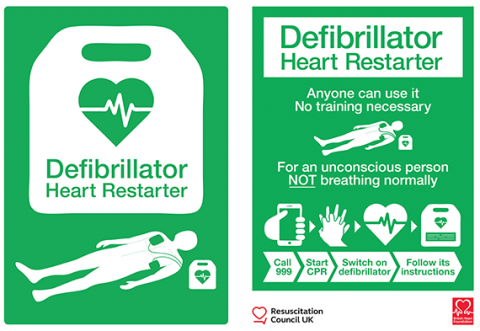
Defibrillators are popping up across communities in the UK. They might be on the outside of buildings or inside large public spaces such as shopping centres and airports. The defibrillator or the case it sits in may say ‘AED’ or ‘defibrillator’ and may have an image of a green heart on the outside. You might also see a green informational poster next to a defibrillator, which we developed with the BHF to raise awareness of the location of defibs.
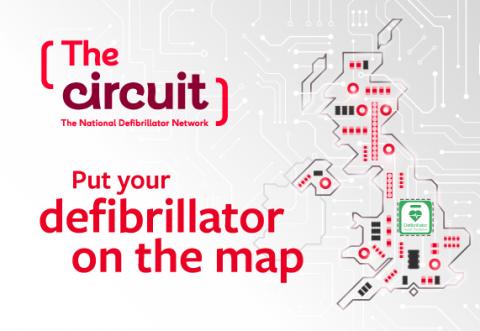
There are also other initiatives to make sure we can all find our nearest defibs quickly in an emergency. One example is The Circuit, which is a drive by the BHF with support from Resuscitation Council UK to create a network of defibrillators that are registered with ambulance services, ensuring the public can locate their nearest defibrillator. There’s also GoodSAM, which has mapped thousands of public access defibrillators across London.
Defibrillator guidance for communities
It’s vital that members of the public can quickly access defibrillators in an emergency. If you are interested in getting a defibrillator installed in your local area, read our AED guide which provides useful information on how to fund a defibrillator, where to install one and how to maintain them after installation.
In 2024, in collaboration with British Heart Foundation, Oliver Cookson Foundation, and St John Ambulance, we proudly published the Heartsafe Communities Report. Focused on Wythenshawe, Manchester, the project set out to improve access to defibrillators and succeeded in cutting the average round-trip time from 14 minutes to just six-and-a-half. We hope this project can provide a model for improving access to CPR training and defibrillators in communities across the UK.
Understanding Implantable Cardioverter Defibrillators (ICDs)
What do ICDs do?
Implantable cardioverter defibrillators (ICDs) continuously monitor the heart rhythm and respond immediately if an abnormal rhythm is detected. It can deliver an electric shock to restore a normal heartbeat and prevent a cardiac arrest.
Who are they for?
ICDs are used for people who have survived a cardiac arrest or who are at high risk of a fatal heart rhythm, providing ongoing protection to help prevent against sudden cardiac death.
How is an ICD is fitted?
You’ll be given a local anaesthetic to numb the area, so you’ll be awake but should not feel pain. Some people are also given medication to help them relax.
A small incision is made in the chest, usually on the left side. Thin wires (leads) are then passed through a vein into the heart, where they help monitor the heart’s rhythm.
The ICD device is placed under the skin in the chest and connected to these wires. The incision is then closed.
For a subcutaneous ICD (S-ICD), the leads are positioned under the skin rather than inside the heart, and the ICD device is placed under the skin at the side of the chest.
Template letter for defibrillator guardians
At present, there is an alarming inconsistency in the insurance industry’s approach when offering cover for ‘Rescue Ready’ cabinets in community settings. This is threatening many lives across the United Kingdom.
RCUK has produced a template letter for guardians of defibrillators, to request that their insurance company provides cover for unlocked, ‘Rescue Ready’ cabinets containing automated external defibrillators (AEDs).
As guardian of a defibrillator, we recognise you are responsible for ensuring your device remains in a ready to rescue state at all times. Devices located within a community setting play a crucial role in shortening the time ‘from collapse to first shock’ for the general public.
Please consider using this template letter to insurance companies, which references the consensus statement written by the Resuscitation Council UK, and supported by the British Heart Foundation, on the importance of unlocked cabinets in saving lives.