
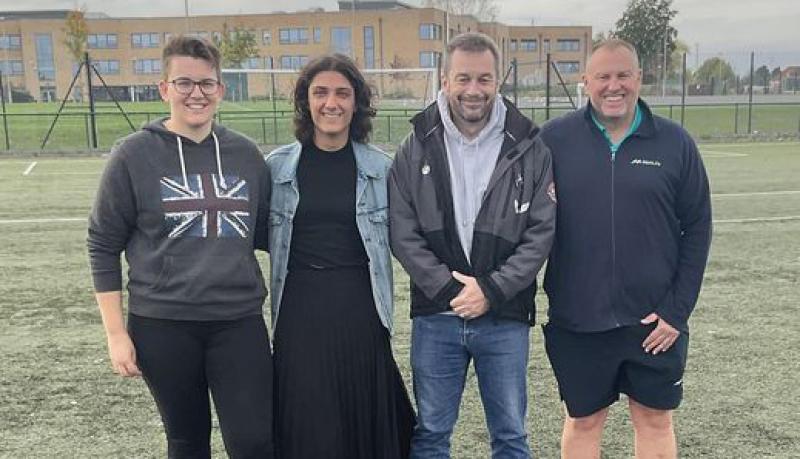
Whilst playing walking football for Carmarthen Town at Caldicot Leisure Centre in 2022, Alan Owen suffered an out-of-hospital cardiac arrest during a league fixture involving several clubs.
After playing in the opening six-a-side match, Alan was standing with friends watching another game when he suddenly began to feel unwell and collapsed. Fortunately, those around him acted immediately. One of Alan’s friends, a former police officer, quickly placed him in the recovery position, while another friend with a military background came to assist.
As the situation unfolded, Carmarthen Town’s football manager called 999. When it became clear that Alan was not breathing, CPR was started without delay. Staff at the leisure centre also responded rapidly. A trained emergency response team arrived at Alan’s side carrying emergency equipment, including a defibrillator. Three shocks were delivered before his heart restarted. Alan had been without a heartbeat for around eight minutes. Among those witnessing the incident was Alan’s 15-year-old son.
Alan was critically unwell, and clinicians made the decision to place him on a ventilator at the pitchside. Alan was transferred to University Hospital of Wales, where he was treated in the resuscitation room of the emergency department before undergoing further assessment in the cardiac intervention suite.
He was diagnosed with hypertrophic cardiomyopathy, a condition that can increase the risk of sudden cardiac arrest. As a precaution, two stents were fitted, along with an implantable cardioverter defibrillator (ICD). Alan spent a total of 11 days in hospital recovering.
Alan believes that without the immediate actions of those around him, access to a defibrillator, and the expert care provided by the Wales Air Ambulance and NHS teams, he would not have survived. His experience highlights the vital importance of early CPR, rapid defibrillation, and prepared responders in helping to save lives following cardiac arrest.